My Stardust Observatory
  • Home
  • Introduction
  • Astro Blog
  • Education
    • NASA's Saturn Observation Campaign
    • Stardust Astronomy Club
  • Space Lego
  • Astro Links
  • Astro Events
  • Contact Me

Helix Nebula (NGC7293) planetary nebula in constellation of Aquarius

1/30/2026

0 Comments

 
Picture
The Helix nebula is like our own star the Sun, it has exhausted its fuel and is now expelling its outer layers, all that’s left of the original star is a dense white core that is exciting all the expelled dust and gas from the stellar remnant.
 
The Helix is approximately 650 light-years from Earth and is one of the closest planetary nebulae to Earth; it is sometimes refereed to the Eye of God due to its resemblance to a giant eye in the sky.
 
This image was taken with just the little Seestar S50mm telescope; I was at my Stardust Observatory at Leyburn in a very dark sky. The capture time was one and a half hours. Image was processed in Photoshop.
 
To find out more about this amazing object please go to Science at NASA at:
https://science.nasa.gov/mission/hubble/science/explore-the-night-sky/hubble-caldwell-catalog/caldwell-63/
 
To find where the Helix Nebula is in Aquarius please go to FREE star chart:
https://freestarcharts.com/ngc-7293
​
Picture
Star Chart Credit: freecharts.com
0 Comments

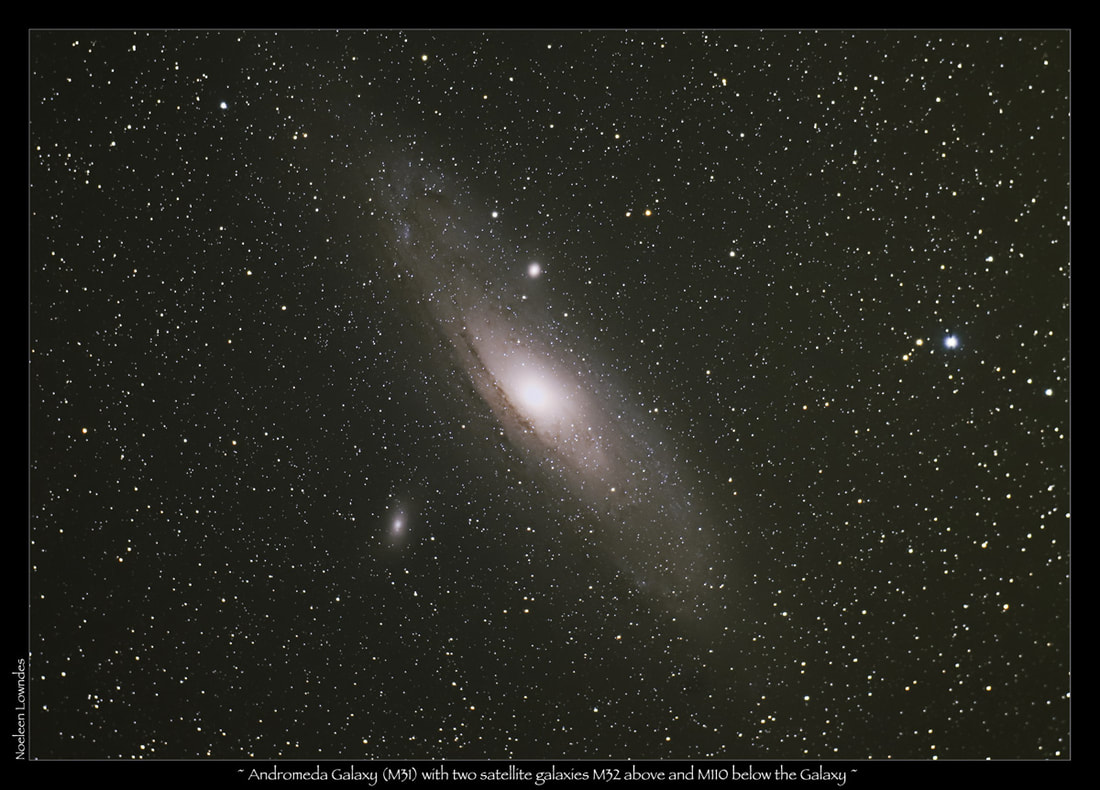
~ Andromeda Galaxy (M31) & it’s two satellite Galaxies M110 & M32 ~

1/5/2026

0 Comments

 
Picture
PictureCredit: freestarcharts.com at: https://freestarcharts.com/
~ Magnificent Andromeda Galaxy (M31) & it’s two satellite Galaxies M110 & M32 ~
 
This beautiful image of the magnificent Andromeda Galaxy was taken with just the little Seestar S50 telescope on the wide field setting; it’s an incredible 2.5 million light-years away from Earth!
 
If you go into the Seestar App settings you can orientate the object using the mosaic mode to fit in what you want to capture and its orientation.
 
I’m just blown away that this little telescope has captured an image like this, when I image this object usually I use my Meade 80mm refractor telescope that’s tracking on the larger Meade LX200 set up in the observatory.
 
Andromeda travels quite low in our northern sky at my observing location at 28 degrees south, I also have some high gum trees to contend with as well.
 
We have a time limit of just a couple of months as the galaxy skims low across the northern sky, November and December are the best times to capture it but by January it’s starting to descend down into the north western horizon.
 
You can still observe Andromeda in early January just after dark, but it’s now getting very low in the north western sky.
 
Images were taken with the Seestar S50mm telescope, on the new moon weekend at the end of November 2025, 2 ½ hours of images were stacked within the telescope then processed in PS. I was in a very dark sky location at my Stardust Observatory at Leyburn.
 
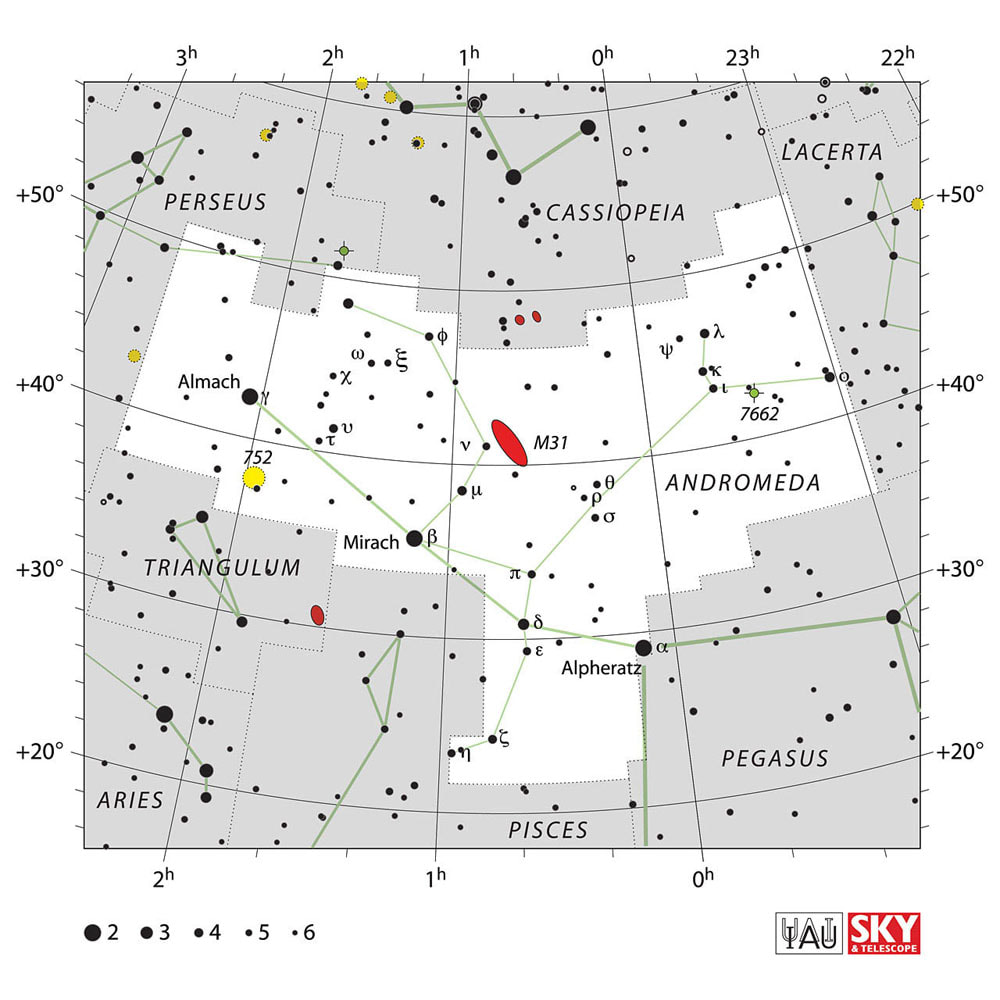
If you need FREE star charts of the night sky that contain so much information of the objects in those constellation then please go to freestarcharts.com at: https://freestarcharts.com/
 
Andromeda Star chart below at:
https://freestarcharts.com/andromeda
​
Messier 31
M31, also well known as the Andromeda Galaxy, is the nearest major galaxy to our own, the Milky Way.
 
Science at NASA has released incredible images of the Andromeda taken over a ten-year period with the Hubble Space telescope with links to all the new discoveries about this incredible galaxy that is much like our own. Link at:
https://science.nasa.gov/mission/hubble/science/explore-the-night-sky/hubble-messier-catalog/messier-31/

NASA Goddard Space Centre – Andromeda Galaxy (M31)
2.5 Billion Pixel Image of Galaxy Shot by Hubble
The Andromeda galaxy holds over 1 trillion stars and has been a key to unlocking the secrets of the universe. Thanks to NASA’s Hubble Space Telescope, we’re now seeing Andromeda in stunning new detail, revealing its dynamic history and unique structure. Recent Hubble surveys mapped the galaxy’s entire disk—an effort spanning a decade and over 1,000 orbits—showing everything from young stars to remnants of past galactic collisions.
 
Learn how new information about Andromeda is reshaping our understanding of galactic evolution and what it reveals about the fate of our own galaxy.
 
For more information, visit https://nasa.gov/hubble.
 
Credit: NASA's Goddard Space Flight Center Paul Morris: Lead Producer Music Credit: “Vitava From Ma Vlast "My Country"” by Bedrich Smetana [PD] and Robert J Walsh [BMI], via First Digital Music [BMI] and Universal Production Music.
0 Comments

~ The secrets of the Universe ~ NASA Releases 25 Jaw-Dropping Space Images of 2025

12/28/2025

0 Comments

 
~ This is just so beautiful ~

​Take a journey across space and time through the best space images of 2025, captured by NASA’s James Webb Space Telescope, Hubble, Chandra, and other powerful observatories.
 
From newborn stars hidden inside dusty nebulae to the shattered remains of supernovae, and from distant galaxies to interstellar visitors passing through our solar system, each image reveals a different chapter of the universe’s story.
 
Webb’s infrared vision, Hubble’s clarity, and Chandra’s X-ray perspective come together to show how stars form, how galaxies evolve, and how unseen forces shape the cosmos.
 
MUSIC Alignment in Grace 3 Stereo Nuts Interstellar Alignment in Grace 2
 
https://youtu.be/MRfU9RR95A4?si=jcKqr92yuffdHrg9
​
0 Comments

~ Jupiter with its rustic coloured Belts & Zones on 24th November 2025 ~

11/24/2025

0 Comments

 
Picture
~ Jupiter with coloured Belts & Zones, festoons & bright white oval on 24th November 2025 ~
 
Jupiter will be at opposition with our planet on the 10th January 2026, the planet can be found at the moment in the constellation of Gemini (The Twins).
 
This image was taken on the last new Moon weekend at the end of November and it shows quite a lot of detail as our two planets come closer together in the night sky.
 
The image shows the prominent coloured belts (dark bands) and zones (lighter bands) with some lovely dark blue festoons and a bright white oval spot on the North Equatorial Belt. This image is on the opposite side of Jupiter to its GRS (Great Red Spot).
 
This is the best time now to grab your telescope to view this magnificent planet and take some images, the bigger the aperture of your telescope the clearer the view of the planet.
 
The image was taken with a Meade LX200 10 inch Schmidt-Cassegrain in my Stardust Observatory at Leyburn, using a ZWO ASI120 MC camera with a 3x Barlow attached. AVI movies were captured with 3000 frames. The frames were then stacked in RegiStax6 and processed in PS.
Picture
0 Comments

~ Saturn’s rare ring plane crossing on the 23rd November 2025 ~

11/23/2025

0 Comments

 
Picture
In between severe thunderstorms out at my observatory, I was able to capture this rare event where Saturn’s rings were so thin that they nearly disappeared completely from view!
 
This is a rare celestial event that only happens approximately every 15 years as Earth crosses through the ring plane of Saturn, that is why we see the rings so thin and are viewed edge on from our position here on planet Earth.
 
But this is only an illusion as Saturn’s beautiful rings are still there in all there glory but we just cannot see them from Earth.
 
Galileo Galilei was perplexed when in 1612 he looked at Saturn and its beautiful rings had disappeared this is what he stated in his notes!
 
"I do not know what to say in a case so surprising, so unlooked for and so novel." announced Galileo when Saturn's rings appeared to vanish in 1612.
Read more at: https://apod.nasa.gov/apod/ap950801.html
 
More interesting information on Saturn’s ring plane crossings from NASA:
https://science.nasa.gov/missions/hubble/hubble-views-saturn-ring-plane-crossing/
 
My images were taken with a 10inch LX200 Meade Schmidt-Cassegrain telescope and ZWO ASI120 Mc planetary camera with 3xbarlow attached. AVI files were captured with 3000 frames that were stacked in RegiStax6 and processed in PS.
 
The sky conditions were not ideal with quite a lot of water moisture in the air,
but I managed to capture some AVI files :-)
0 Comments

~ Comet C/2025 R2 (SWAN) low in western sky 21st September 2025 ~

9/21/2025

0 Comments

 
Picture
Picture

​I managed to quickly set up the little Seestar S50 telescope just outside our cabin in town and capture this stunning comet low in the western sky.

It was not ideal conditions because of all the lights from the local hotel that was across the road…but I took the chance and I caught myself a beautiful comet :-)

​ I love the pretty green colour of the coma and its long delicate flyaway tail that stretched right up the sky. Images taken with a Seestar S50 telescope four images were stacked in DSS and very lightly processed in PS, the pretty green colour in the image is natural.

There is an excellent article from the UNSW in Australia that explains why comets heads are green by chemist Professor Timothy Schmidt, the link is at: https://www.unsw.edu.au/newsroom/news/2021/12/comets--heads-can-be-green--but-never-their-tails--after-90-year
​


0 Comments

​~ Saturn at opposition in 2025 with its moons Titan and Rhea ~

9/21/2025

0 Comments

 
Picture~ Gas Giants App ~
​I’m out at my observatory this new moon weekend specifically to capture Saturn at opposition; the sky is just so clear and magnificent. Saturn looks so beautiful up in the night sky in the faint constellation of Pisces (The Fishes).
 
These images of Saturn were taken at opposition on the 20th September 2025 with my 10-inch Meade Schmidt-Cassegrain LX200 telescope using a ZWO ASI120 MC camera with a 3x Barlow lens attached. AVI video files were captured with 3000 frames then stacked in RegiStax6 and processed in PS.
 
You can see two of Saturn’s moon very clearly in the image, the largest moon Titan is above the thin ring and Rhea is at the tip below the ring.
 
There is an excellent App called Gas Giants that helps identify Saturn’s satellites (also Jupiter) in real time, the ZWO Seestar App also gives excellent information which I’ve include here in my blog on Saturn’s opposition.
 
https://apps.apple.com/us/app/gas-giants/id397831483
 
I must say, I’m extremely happy with the detail in this image and the edge on rings in silhouette looks amazing  :-)

Picture
0 Comments

~ The Sun our awesome Star at Helensvale Library 16th May 2025 ~

5/17/2025

0 Comments

 
Presented by Noeleen Lowndes from the Southern Astronomical Society
https://www.sas.org.au
https://www.goldcoast.qld.gov.au/libraries/Home
 
What a lovely morning I had with all the people from the Savvy Seniors group at the Helensvale Library here on the Gold Coast.
 
 I was invited again to give a presentation on astronomy and this time because of solar activity on the Sun during this year of solar maximum; I chose to talk about our awesome Sun.
 
These presentations are always a lot of fun because I can show and talk about all my solar images, and then enlighten people on how important this celestial object is for life on our planet Earth.
 
A great day was had by all, Noeleen :-)
Picture
0 Comments

~ Mars in Constellation of Cancer near Beehive open star cluster M44 ~

5/1/2025

0 Comments

 
I’m out at my Stardust Observatory for the long new Moon weekend and finally we have had a few evenings of clear sky. The red planet Mars is now in the constellation of Cancer and moving towards the Beehive cluster also known as M44.
 
I’ve taken a wide field image of the planet among the stars of Cancer using Canon 70D camera with a 70-200mm Canon Lens attached to my tracking telescope in the observatory on Sunday the 28th April at 8pm.
 
20 x 2-minute images with corresponding dark frames were captured with ISO 1250, then stacked in Deep Sky Stacker (DSS) and processed in PS.
Picture
~ Mars taken with Meade 10” Schmidt-Cassegrain telescope ~
Mars is looking very small now in the 10inch telescope, captured the planet with a ZWO ASI 120MC planetary camera with attached 3x Barlow lens.

You can just make out the polar cap at the bottom of the planet and some dark marking can still be seen on the surface.
 
Information on my Stellarium App states that Mars currently is 6.70” in diameter is at 0.90% phase and its distance is now 1.40AU. Stellarium App at: https://stellarium-labs.com/stellarium-mobile-plus/
 
I use this FREE App all the time for my sky observation, its excellent!


​~ The Beehive Star Cluster also known as (M44)& NGC 2632 ~ 
In the constellation of Cancer (The Crab) 

Picture
This image was taken with the little Seestar S50 smart telescope when I was at my Stardust Observatory on the evening of the 28th April 2025.
 
I thought it would be fun to see what this little telescope could do in a really dark sky and I was most impressed! Not only does it show the subtle colours of the stars if you look closely into the image you can see a tiny spiral galaxy designation as UGC 4526, its magnitude is a remarkable 14.06…now that’s very faint.
 
It’s estimated that this star cluster is about 600 light years away from Earth.
 
For more information about the Beehive Cluster (M44) please go to the link below:
https://en.wikipedia.org/wiki/Cancer_(constellation)
Picture
Credit: IAU star map of Cancer
0 Comments

~ Wow! Comet ATLAS (C/2024 G3) in western sky at Mt Tamborine ~

1/21/2025

0 Comments

 
Picture
We were not expecting that!
 
I grabbed my husband and camera and raced up to the top of Mt Tamborine to try and see if we could see the comet…. and Wow, I spotted the comets tail still in the very light twilight sky, which was amazing. As it got a little darker it came out in all its glory :-D
 
It was a bit smoggy from a bush fire low on the horizon, and I think that’s why the coma area of the comet was glowing a golden colour.
 
Images were taken between 7.30 – 8pm 20th January 2025, with a Canon 70D camera and Tamron 18-40mm lens on a tripod with exposures from a couple of seconds up to 30 seconds; ISO was from 200 to 1600.
Picture
0 Comments
<<Previous

    Author

    I just love being under the heavens, come on a journey with me and I’ll share some of the amazing wonders of the Universe with you. Noeleen :-)

    Picture

    Archives

    February 2026
    January 2026
    December 2025
    November 2025
    October 2025
    September 2025
    August 2025
    July 2025
    June 2025
    May 2025
    April 2025
    March 2025
    February 2025
    January 2025
    December 2024
    November 2024
    October 2024
    September 2024
    August 2024
    July 2024
    June 2024
    May 2024
    April 2024
    March 2024
    February 2024
    January 2024
    December 2023
    November 2023
    October 2023
    September 2023
    August 2023
    July 2023
    June 2023
    May 2023
    April 2023
    March 2023
    February 2023
    January 2023
    December 2022
    November 2022
    October 2022
    September 2022
    August 2022
    July 2022
    June 2022
    May 2022
    April 2022
    March 2022
    February 2022
    January 2022
    December 2021
    November 2021
    October 2021
    September 2021
    August 2021
    July 2021
    June 2021
    May 2021
    April 2021
    March 2021
    February 2021
    January 2021
    December 2020
    November 2020
    October 2020
    September 2020
    August 2020
    July 2020
    June 2020
    May 2020
    April 2020
    March 2020
    February 2020
    January 2020
    December 2019
    November 2019
    October 2019
    September 2019
    August 2019
    July 2019
    June 2019
    May 2019
    April 2019
    March 2019
    February 2019
    January 2019
    December 2018
    October 2018
    September 2018
    August 2018
    July 2018
    June 2018
    May 2018
    April 2018
    March 2018
    February 2018
    January 2018
    December 2017
    November 2017
    October 2017
    September 2017
    August 2017
    July 2017
    June 2017
    May 2017
    April 2017
    March 2017
    February 2017
    January 2017
    December 2016
    November 2016
    September 2016
    August 2016
    July 2016
    May 2016
    April 2016
    March 2016
    February 2016
    January 2016
    December 2015
    November 2015
    October 2015
    September 2015
    August 2015
    July 2015
    June 2015
    May 2015
    April 2015
    March 2015
    February 2015
    January 2015
    December 2014
    November 2014
    October 2014
    September 2014
    August 2014
    July 2014
    June 2014
    May 2014
    April 2014
    March 2014
    February 2014
    January 2014
    December 2013
    November 2013
    October 2013
    August 2013
    July 2013
    June 2013
    May 2013
    November 2012
    October 2012

    RSS Feed

    Categories

    All
    Annular Eclipse
    Astronomy Event
    Canon Camera And Lens
    Comets
    Deep Sky Object
    Education
    Equipment
    Lunar Eclipse
    Moon
    Observatory
    Planets
    Seestar S50
    Seestar Sun
    Sky Phenomena
    Software
    Solar Filter And Camera Lens
    Solar Telescope
    Sun And Sunspots
    Total Solar Eclipse
    Travel

Picture
For all current observations of the night sky please go to my Astro Blog:
http://www.mystardustobservatory.com/astro-blog

​
​Copyright information: 

You are welcome to use my images for educational and private use, please credit me.
If you need higher resolution images then please contact me on my contact page, thank you.